Kevin Warsh began his term with a clean break from the Powell era. Out went the forward guidance, in came a more direct approach and sharply rising inflation forecasts. This was enough to stretch the yield curve, boost the dollar, and remind investors that fighting inflation remains the Fed’s top priority.
The first speech by the new Fed chairman , Kevin Warsh, last night, was one of the highlights of the week. Several « surprises » were in store.
First, in terms of format, Jerome Powell’s successor eliminated « forward guidance , » the forward-looking statements that had previously provided economists and investors with benchmarks for the most likely path of monetary policy. Another formal change: the statement was considerably shortened, from just over 300 words to around 100. The stated intention is clear: to get straight to the point by reducing the level of detail.
On the substance, the announcements did not entirely meet economists’ initial expectations. The Fed raised its inflation forecast, now expected to reach 3.6% by the end of the year, compared to 2.7% in March . While this revision can be explained by the rise in oil prices in the interim, some anticipated a less hawkish tone , especially given the recent easing of oil prices and the recent signing of a memorandum of understanding between Iran and the United States. Many also felt that Donald Trump, who favored lower interest rates, could have exerted more influence on the comments of his new Fed chairman.
Consequently, Fed members’ projections now point to a policy rate of 3.8% by year-end. With the current range of 3.50% to 3.75%, this implies another hike by December, according to the dot-com plot. Before the Iran-US conflict, the consensus anticipated a future rate cut; and with the recent geopolitical lull, some thought the Fed would factor this in and maintain the status quo . This has not been the case: the fight against inflation remains the top priority, even at the expense of growth – GDP forecasts have, in fact, been lowered to 2.2%.
Inflation: the specter of a post-Covid scenario resurfaces
The most visible reaction on the markets concerned the dollar, which strengthened significantly against most currencies (see orange ellipse below with the DXY index ).
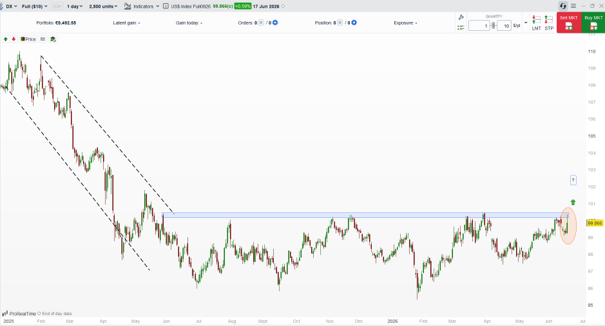
Evolution of the DXY index since 2025
Source: ProRealTime
We should also note a slight rebound in US bonds last night , a rebound which however subsided this morning following the announcement of the Iran-US agreement.
Finally, the combination of « upwardly revised inflation and downwardly revised growth » has led to a flattening of the yield curve. This is reflected in the evolution of the spread between 10-year and 2-year yields (see yellow ellipse below).
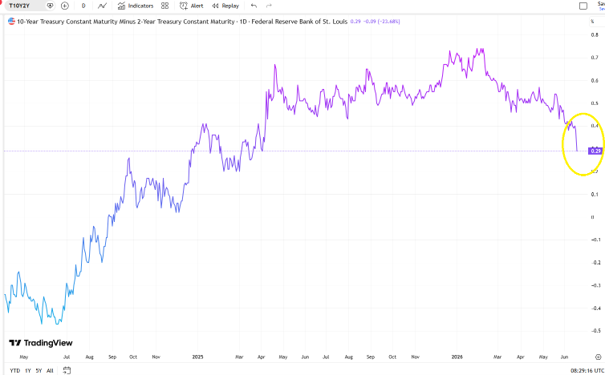
Evolution of the spread between 10-year and 2-year US Treasury bonds since May 2024.
Source: TradingView
Taking a step back, we can fear a configuration reminiscent of that observed after Covid, between the end of 2021 and 2023 (see yellow box below).
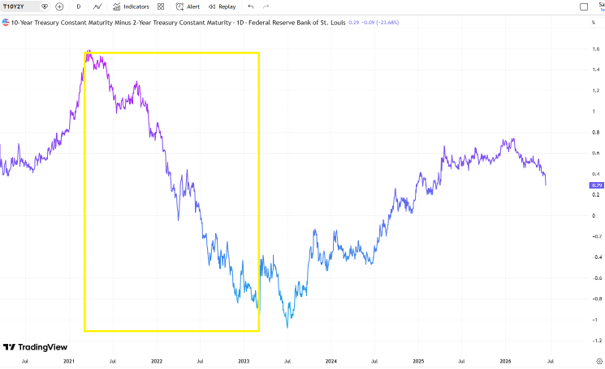
Evolution of the spread between 10-year and 2-year US Treasury bonds since July 2020.
Source: TradingView
The conflict in Ukraine fueled the trend in 2022. If history were to repeat itself, it is worth remembering that the period was not favorable to the markets: the S&P 500 had moved in a downward trend between the end of 2021 and the beginning of 2023.
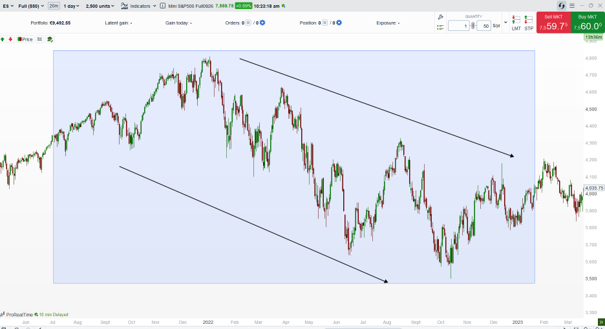
Performance of the S&P 500 index since 2021
Source: ProRealTime